AI Engineering
Services for industry are the work that helps industrial firms run,
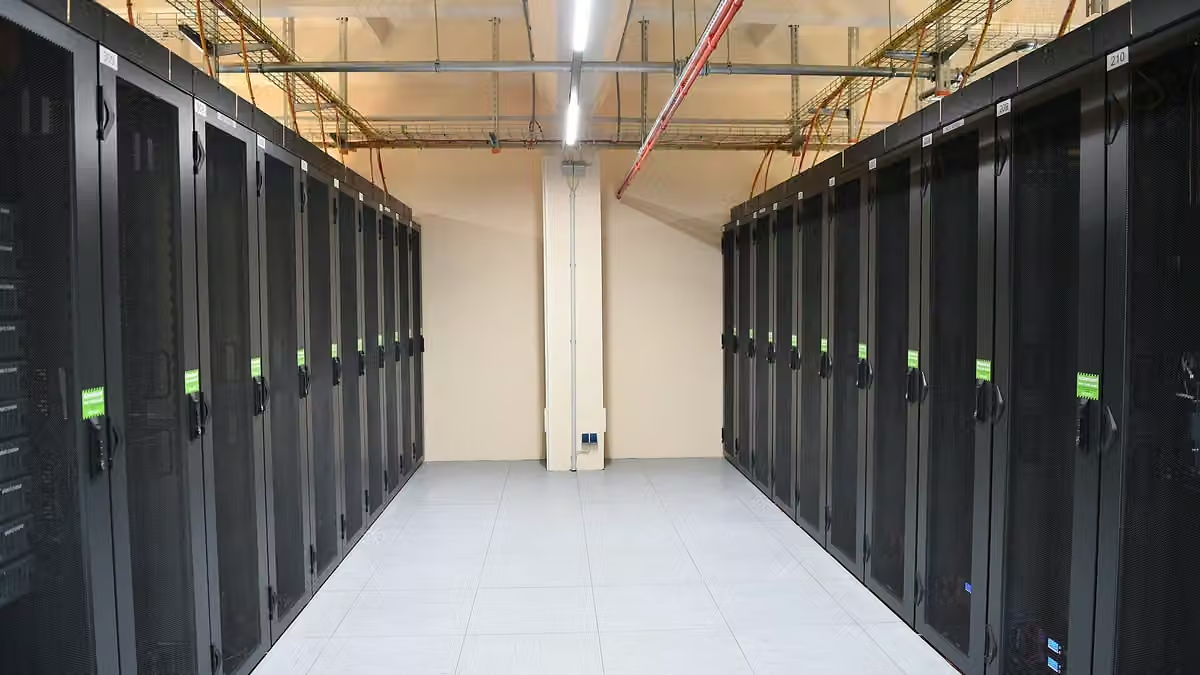
Services for industry are the work that helps industrial firms run, change, and scale their operations. In AI engineering, that usually means building systems that sit close to production work, such as data pipelines, model deployment, monitoring, quality checks, and automation tied to real business processes.
I keep coming back to one plain fact: these services are useful because they sit between strategy and the plant floor, or between an idea and a live system. They are not only advice. They are also build work, integration work, and support work. In practice, that can include AI consulting, custom model development, MLOps, data engineering, and ongoing operation after launch.
The phrase can sound broad, so I want to narrow it carefully. In industrial settings, services often cover technical, field-based, and compliance-led work that keeps assets safe and efficient. In AI and digital work, the same idea extends to governed data platforms, model monitoring, edge systems, and enterprise workflows that must keep working after the pilot ends.
That is the core answer. Services for industry are the practical services that help industrial organizations produce, maintain, inspect, predict, and improve. In AI engineering, this often means turning models into tools that can survive real use, with rules, oversight, and support around them.
What matters most is the shift from demo to operation. Many teams can show a proof of concept. Fewer can keep a system stable when data changes, users change, or compliance needs tighten. That gap is where industrial services and AI engineering overlap.
I think the real value is in that overlap. The service is not just the model. It is the full path around it: data capture, deployment, monitoring, retraining, audit readiness, and user fit. Without those parts, the work often stays stuck in test mode.
There is also a business side to this. Industrial services are often traded between companies to support the making of final products, not as the final product itself. That means the buyer is usually looking for uptime, speed, quality, and lower risk, not just new software features.
For AI teams, that changes the shape of the job. The work is less about a clean notebook and more about messy reality. Data may be incomplete. Processes may be old. The system may need to work at the edge, in a factory, or across many sites. So the service has to fit the environment, not just the model.
This is why terms like AI engineering, engineering-led services, and managed AI services keep showing up in the same conversation. They point to the same need: build something useful, then keep it useful. That can include governance, observability, security, and support for the business teams that depend on it.
I want to keep one limit clear. The term services for industry is not perfectly fixed. Different firms use it in different ways. Some mean traditional industrial support. Some mean digital services for manufacturers and operators. Some mean full AI and engineering delivery. The label is broad, so the details matter more than the name.
That uncertainty is not a flaw. It is part of the market. Buyers often care less about the term and more about whether the service can handle their process, their data, and their risk rules. That is where the real comparison happens.
So the simplest reading is this: services for industry are the work that keeps industrial systems moving, and in AI engineering that now includes data, models, deployment, and ongoing control. It is a practical, often unglamorous layer of work, but it is the layer that turns technical ideas into something a business can actually use.
That is also why this topic stays close to the work FDE Alliance Brief follows. The useful signals are usually in the real operating details, the hiring patterns around them, and the alliance moves that shape how these services get built and delivered.
More on: AI Engineering